

Objectivity Was Never Neutral
Leaving Gaza did not stop the work. It only changed how it followed me. By Mohammed R. Mhawish


Nearly two years ago, I was packing to flee Gaza, trying to decide what I could carry and what I had to leave behind. By then, I had already been reporting for months on Israel’s bombardment campaign from Gaza City, filing dispatches and breaking news from wherever I could find signal. During airstrikes, I would compose leads in my head; it gave me something to hold onto. I understood that if I could turn what was happening into meaningful sentences, I could keep a small distance from it. At the time, I told myself this was how I would stay professional even though nothing around me was. Looking back, I’m not sure it wasn’t just a way to cope.
In those dispatches, what I didn’t say and what I’m still learning how to say, is that I was living inside the same stories I was reporting. In my attempts to write through the shelling, I was also mourning everything I had loved: my colleagues, my neighborhood, my teachers, my friends, and everything that had made Gaza home for twenty-five years. When I called editors to discuss framing or word count, I was sometimes standing in buildings that had already been hit at least once. The question of how to write about Gaza became personal and could no longer be separated from the professional responsibility. I thought of it then as a dual role—being both the reporter and part of the story. I didn’t yet understand that it was simply the reality of the work, which so quickly becomes the cost.
That cost has shifted depending on where I have moved. In Gaza, my reporting had to be quick. There was no time to sit with the losses that kept coming, let alone grieve them. When I crossed into Egypt on April 17, 2024, I thought I was stepping out of that cost. I simply thought distance would mean relief. Little did I know, leaving only changed how it followed me.
In Cairo, for the first time in a long time, I finally had a sense of normalcy with a stable internet connection and time that wasn’t immediately filled with urgency. And that’s when everything I had pushed aside started to catch up with me. Grief came to me differently. It didn’t disappear because I’ve moved somewhere safer. Usually, I would sit in a café trying to translate an interview and suddenly stop, caught by something closer to a choke of feeling I hadn’t let myself feel in Gaza. Physical safety did not stop my body from registering what it had been through.
That distance also changed the shape of my reporting. In Gaza, I hadn’t felt the need to build context in the same way I found myself obliged to in Egypt. The people I spoke to were people I knew, the places I described were places I knew by memory. From Cairo, though, I needed more calls and confirmations, and most of the time, I had to ask people to describe things I could picture but couldn’t be sure were still the same. The landscape was changing far from me, and I feared my understanding would fall behind it.
Reporters sometimes fall into the trap of urgency, filing as many stories and quick portraits as possible within the shortest span of time. During wartime reporting, that is not entirely wrong; part of the responsibility is keeping the world informed in real time as things unfold. But what gets lost along the way, and I’ve fallen into this too, is that urgency flattens the thing it claims to explain, and the cost of that flattening falls on the people left inside it. I have tried to resist it by asking for more time, conducting longer interviews, chasing details that were harder to reach from thousands of miles away. The effort is greater precisely because the proximity is gone. Without it, the reporting drifts into material that functions like journalism without quite being it.
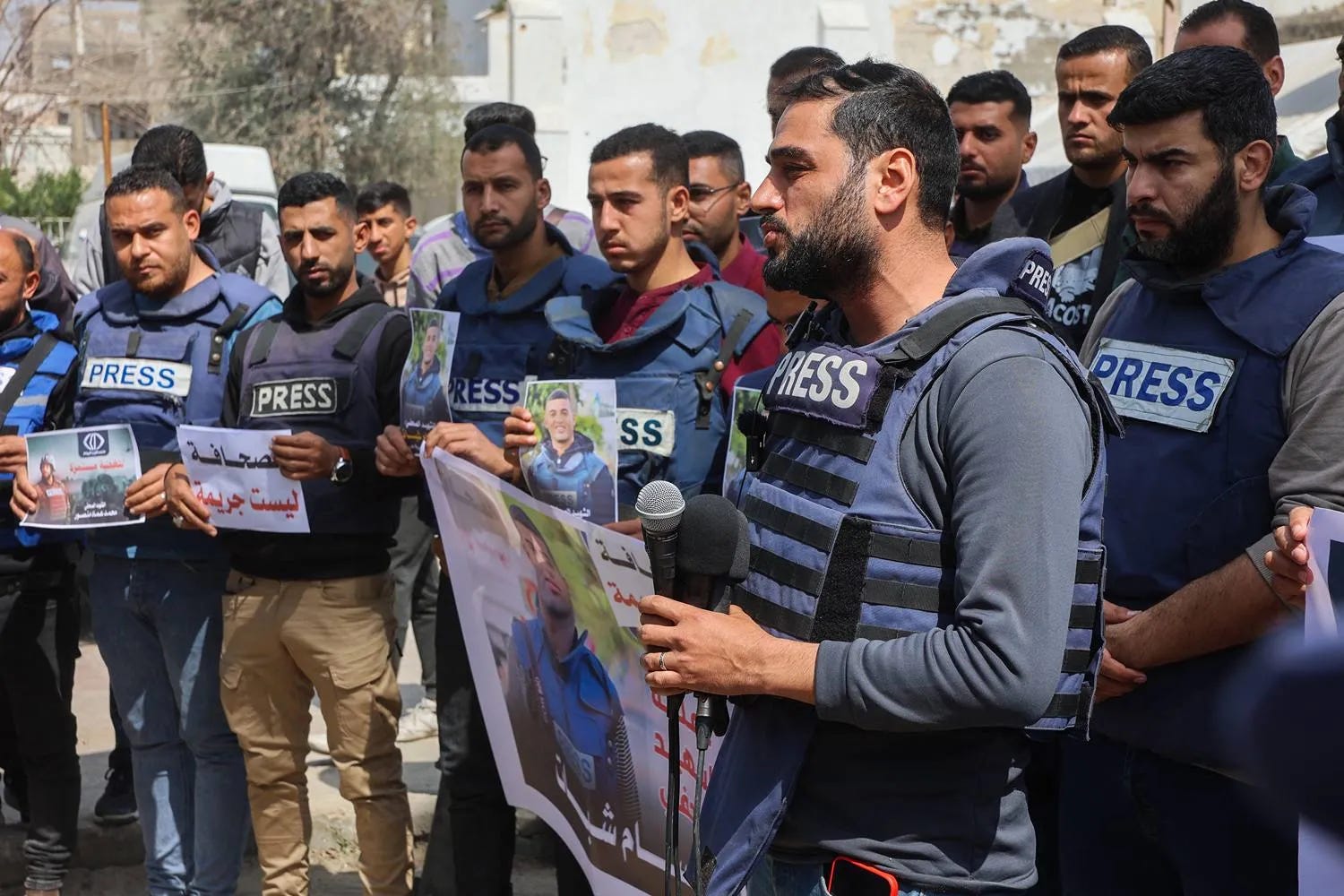
Consider what access actually means in Gaza when it is not a methodology or a technique transferable from one context to another. Gaza has spent seventeen years under a blockade designed to keep the economy on the brink of collapse without tipping it over—a policy of calibrated suffering that requires its bureaucracy and euphemism. In that environment, trust has grown into a survival calculus. Before October 7, 2023, people in Gaza had watched foreign journalists arrive and depart, sometimes in ways that endangered them and sometimes that simply erased them, and they learned not to extend themselves easily to strangers with notebooks. The Palestinians’ relationship to outside documentation comes with a history of being documented against oneself: census records used for displacement, while testimony collected and filed under the wrong narrative, and images circulated without context until the context becomes the image.
So when the people I call know me, when they knew my family before I knew how to frame a news story, and ask about my mother before I ask about the strike that destroyed a neighborhood we both have memories in, the interview comes after the personal exchange, because that exchange is what makes the interview real and not performed. It is that part of the work that makes professional conduct possible in these conditions. There is no clean partition between the personal and the work because the work was never partitioned to begin with. Every conversation carries both.
This is a truth that certain editorial frameworks struggle to hold. Western journalism’s model of objectivity—which is not really objectivity but a form of social performance of objectivity, developed in a certain country at a moment in the history of professional guilds—treats the reporter’s distance from the subject as a measure of credibility. The closer the journalist is, the more suspect. This model has always served some reporters better than others. The reporter who covers the Midwest as a native Midwesterner is perceived as authoritative, while the reporter who covers Gaza while being from Gaza is understood as potentially compromised. The asymmetry reflects whose proximity has historically been legible as background and whose has been legible as bias.
I did not fully anticipate how differently this weight would register once I was outside Gaza. In the field, everything was immediate in a way that foreclosed interiority. There was no processing because there was no pause in which processing could occur, and that absence of pause could function as a kind of stability, or what stability looks like when health is not available. We kept reporting because we could not stop. It gets called resilience, though it has always felt more like a suspension of reckoning.
Now the suspension has lifted, and what did not surface then surfaces in my sleepless nights. The bombardment does not remain in the past where it chronologically belongs. It returns to me unpredictably. This is familiar to anyone who has read the clinical literature on post-traumatic stress. However, this clinical literature was mostly written by people who studied it from the outside, and there is something it does not quite capture: the experience of a journalist who is also a subject, reporting on people whose condition is a version of his own, who must take notes during the fragments and then file before deadline. This understanding has arrived, though late, with immense pain.
The professional adjustment fits inside a longer history. Palestinian journalists have always had to translate themselves for Western audiences, not to have their reporting recognized, but to establish their right to report at all. This is partly an effect of how the struggle of their people has been narrated from the outside: as a bilateral dispute between two parties with symmetrical claims, which requires symmetrical distance from all reporters and has the effect of treating Palestinian identity as a form of partisanship. It is also an effect of something older and less specific: the general suspicion, in Western media institutions, of reporters who are from the places they cover, a suspicion that applies unevenly and has consistently applied most heavily to reporters from the Global South.
In certain conversations with international journalists over the past few months, I have watched being Palestinian become a flag raised before my argument is finished. In that environment, my work gets scrutinized differently, a more intense quality of attention, more frequent requests for additional sourcing, a willingness to question framing on stories where framing would not be questioned if the byline were different. I have adapted to this and learned to lead with method: how I know what I know, how the reporting was structured, what multiple sources said and where they disagreed. I make the architecture visible early. It’s not that my background is irrelevant, but if it comes first, it can be used to preempt everything that follows. I have learned to translate the work into a form that forecloses certain dismissals before they arrive.
There is something almost absurd about this, if you follow it to its logical end. The reporting is stronger because of who I am and what I can access. The access requires a proximity that is then understood as a liability. So the work improves and the scrutiny increases in proportion to the same variable.
I keep asking myself, ‘what makes this moment matter now? What has actually shifted? What is specific, concrete, or newly true, every time a new atrocity occurs before my eyes?’ I think the only ethical answer available is precision and depth. The people I report on are people I know, or people who could be people I know without any great stretch of circumstance. When the writing becomes too abstract and drifts from the specific into the representative, when a person becomes a symbol of a category of suffering rather than a person who is suffering specifically, I feel that as a failure that goes deeper than the professional. It is a responsibility I cannot cleanly name but can reliably feel when I’ve violated it.
Being Palestinian runs through all of this in ways that resist the clean taxonomies journalism prefers. It is not quite a disadvantage in the way that word implies a neutral baseline from which I have simply fallen behind, nor is it an asset in the way that word implies something I can deploy and set down. It felt more like a complication, which is a different thing entirely, and it required a new way of managing it by ongoing attention that could not be pushed away.
Palestinian writing has a long tradition of bearing witness with this kind of precision—from Mahmoud Darwish’s refusal to let loss become merely lyrical, to Mourid Barghouti’s attention to the smell of the checkpoint, to Ghassan Kanafani’s characters who carry the weight of history without being crushed into allegory by it. That tradition is instructive. The smallest details are often where the truth is most concentrated, though the journalistic appetite for scale, numbers, timelines, geopolitical consequence, can most often obscure that. This has become the work. It is also how I have continued to make sense of the last two years, to keep going and get back on the phone to find the language that is close to right even when it is not yet all the way there. The gap between the two is where I live. I have learned to work in it without pretending it is not there.
Mohammed R. Mhawish is an award-winning writer and reporter from Gaza City. A contributor to The New Yorker and New York Magazine, Mohammed is a fellow at Type Media Center and a Knight Press Freedom Fellow at the Craig Newmark School of Journalism in New York. His reporting and essays have appeared in MSNBC, This American Life, The Economist, The Nation, and Al Jazeera English. He is a recipient of several journalism awards, including an Izzy Award for Outstanding Achievement in Independent Media, the James Aronson Award for Social Justice Journalism, the Neal Conan Prize for Excellence in Journalism, and two awards from the Arab and Middle Eastern Journalists Association. In 2025, Mhawish was named Storyteller of the Year by the Institute for Middle East Understanding.

 | A guest post by
|
A worthy effort!
See my paper 'Gaza Aerial Survey 2023-2024
Systematic Destruction of Croplands and Groves', 26 February 2926, at https://thenewinvestigator.substack.com/ . You're there on the ground. Any comments on or corrections to what I've written about the wanton destruction of Palestinian agriculture are welcome.
Thank you for your bravery and your honesty and your dedicated attempt to vividly tell/show the brutality and inhumanity